


How to Choose the Right Desk Size for Your Home Office
- by Muzette Alcocer
-
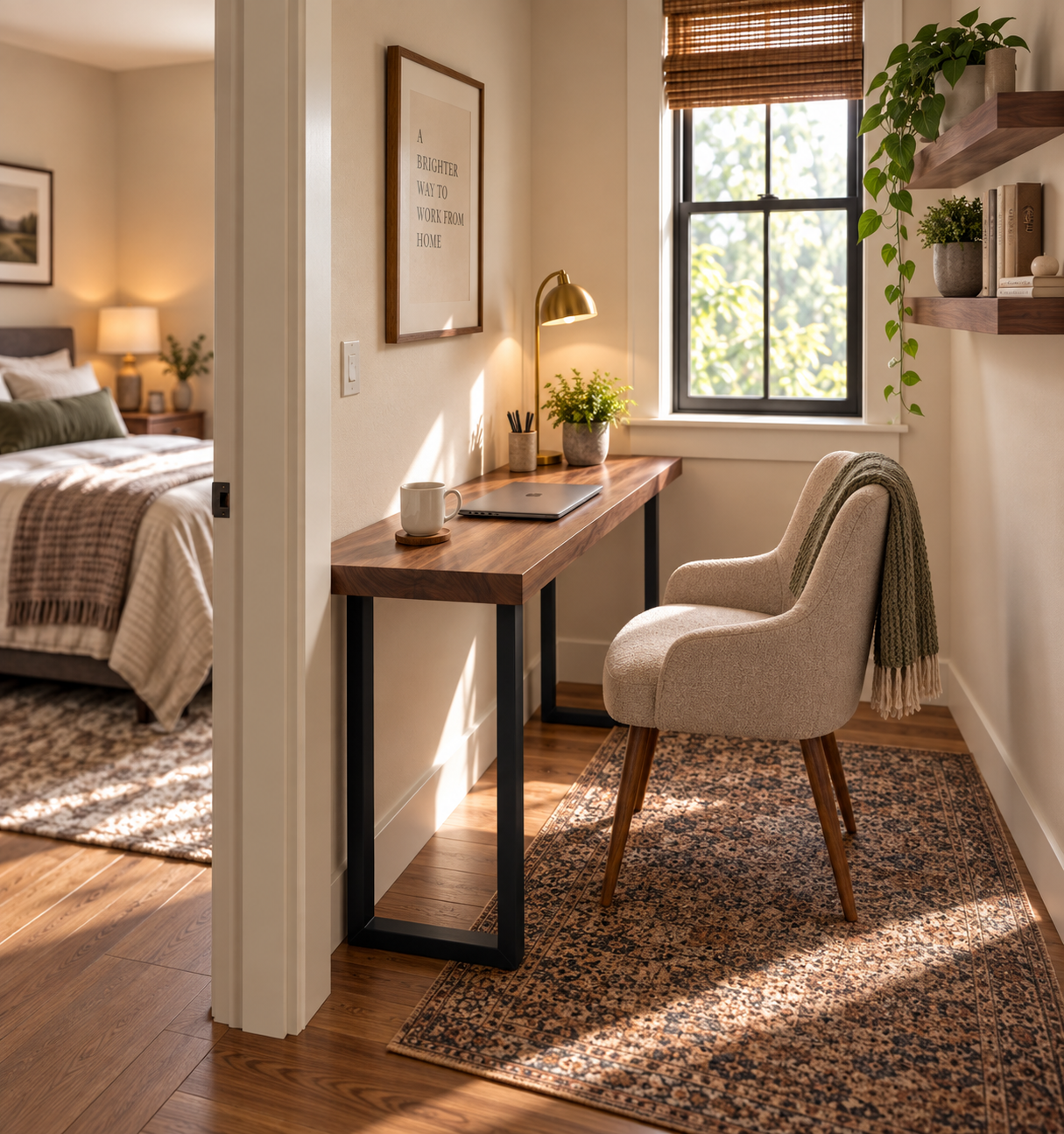
When you're setting up a home office, it's tempting to start by looking for a “standard” desk size. But the best desk isn't necessarily the biggest one you can fit—or the size everyone else seems to have.
The right desk fits the way you work and the space you actually have.
Maybe you have an entire room to turn into an office. Maybe you're working with a small study, a sitting area off the bedroom, or one open wall in a guest room. Either way, choosing the right width, depth, and layout before you buy can make the difference between a workspace that feels comfortable and one that always seems a little too crowded.
Start With Your Room, Not a “Standard” Desk Size
Before deciding how big your desk should be, decide how much of the room it can reasonably occupy.
Measure the wall or corner where you want the desk, but don't stop there. Look at how the entire space functions. Can the door open completely? Is there a closet or drawer nearby that needs clearance? Where are your outlets, windows, and vents? Will you have enough room to pull your chair back and comfortably get in and out?
A desk can technically fit against a wall and still be too large for the room.
And don't overlook spaces that weren't originally intended to be offices. A bedroom sitting area, alcove, wide hallway, or unused corner can become an inviting workspace when the desk is sized for the space instead of the room being forced to accommodate the desk.

Desk Size at a Glance
There isn't one perfect desk dimension for everyone, but these ranges are useful starting points:
| Your Setup | Good Starting Width | Typical Depth to Consider |
|---|---|---|
| Laptop or compact workspace | 40–48" | 16–24" |
| Laptop + monitor / everyday office | 48–60" | 20–30" |
| Two monitors | 60"+ | 24–30"+ |
| Large workstation / multiple screens | 60–72"+ | 30–36" |
| Narrow or multipurpose space | Size to available wall | 12–18" |
These aren't rules. Your actual equipment, room dimensions, and how you use your desk matter more than the number on a sizing chart.
How Wide Should a Home Office Desk Be?
Desk width is usually where people start, and for good reason. You need enough horizontal space for the things you use every day without taking up valuable room with surface area you don't need.
If you primarily use a laptop, a desk around 40–48 inches wide may give you plenty of working room. Add a separate monitor, notebook, or other everyday equipment, and 48–60 inches begins to feel more comfortable.
For two monitors or a workspace where you regularly spread out documents, samples, or other materials, 60 inches or more is a useful place to start.
Before choosing based on monitor size alone, measure the equipment itself. Two “27-inch monitors” don't necessarily require only 54 inches of desk space. Screen dimensions are measured diagonally, while stands, monitor arms, speakers, and the space between screens all affect the actual width you'll need.

How Deep Should a Home Office Desk Be?
Depth is easy to overlook, but in a smaller home office it can be just as important as width.
A very deep desk may give you more surface area, but it also projects farther into the room. Sometimes a longer, narrower desk gives you the workspace you need while preserving more usable floor space.
As a practical starting point:
- 12–16 inches: Very narrow spaces, writing, laptop use, or a streamlined workstation
- 18–24 inches: Compact and everyday home-office setups
- 30–36 inches: Larger workstations, substantial equipment, or people who want more room to spread out
The goal isn't simply to buy the deepest desk available. It's to have enough room for your equipment, comfortable viewing distance, and the way you work without letting the desk overwhelm the room.
For especially tight spaces, our Live Edge Walnut Narrow Desk is an example of how a shallower work surface can create a functional office where a conventional desk might take up too much room. Because the live edge follows the natural outside edge of the wood, each desk has its own shape and character.

What Size Desk Works for Two Monitors?
For many dual-monitor setups, about 60 inches wide is a good starting point, but don't order from that number alone.
Measure the outside width of your monitors after they're positioned the way you plan to use them. Then account for their stands or monitor arms, keyboard, mouse, speakers, docking station, and anything else that normally stays on your desktop.
Depth matters here, too. Larger screens need enough room that you're not sitting uncomfortably close to them.
If you want room for multiple monitors plus notebooks, paperwork, or other equipment, a deeper work surface may make sense. The Solid Walnut Desk With Drawer is one example of how choosing different dimensions can change the way a desk functions in your workspace.
What If Your Home Office Is Small?
This is where we think people get too hung up on the word office.
You don't necessarily need a dedicated room.
You need a place where you can work comfortably.
That may be a small study, an unused corner of a bedroom, a sitting area you rarely use, or a section of a larger room. In those situations, sacrificing a little depth can be much more useful than sacrificing all your width.
A long, narrow desk can provide room for a laptop, monitor, lamp, notebook, and everyday essentials without projecting three feet into the room.
That's the idea: use the space you have instead of waiting for the room you don't.
When Does an L-Shaped Desk Make Sense?
Sometimes the problem isn't that you have too little space. It's that a straight desk doesn't use the space particularly well.
An L-shaped desk can work beautifully when you have an open corner or need separate work zones. One side might hold your monitors and keyboard while the return gives you room for paperwork, a laptop, creative work, or equipment you don't want crowding your primary workspace.
Before choosing one, measure both walls, not just the longest one. Also check which direction you need the return to extend and how the desk will affect doors, windows, and walkways.
Our Solid Wood L-Shaped Desk is built around that idea: a main work surface plus a return, with multiple size configurations available so the layout can work with the room instead of taking it over.

Does Desk Height Matter?
Absolutely—but height is less about finding one universally “correct” number and more about finding a working position that's comfortable for you.
When you're seated, your desk, chair, and keyboard position should work together so you're not constantly reaching upward or hunching forward. Your feet should be supported, and your work surface shouldn't force your shoulders into an unnatural position.
If you prefer changing positions throughout the day, an adjustable desk gives you another option. Artisan Born's Live Edge Walnut Standing Desk is one example of pairing a solid wood work surface with an adjustable-height frame.

When Standard Desk Sizes Don't Fit
This may be the most important measurement advice we can give you:
Your home isn't standard. Your desk doesn't have to be, either.
Older homes have unusual walls. New homes have open floor plans. Bedrooms become offices. Dining rooms become shared workspaces. A window may begin exactly where the “standard” desk ends. Sometimes the perfect place for a workspace is 54 inches wide—not 48 and not 60.
That's one of the reasons we build furniture to order.
At Artisan Born, many of our solid wood desks can be customized by size, wood, and other details to fit the room where they'll actually live. Depending on the design, you can choose hardwoods such as American black walnut or white oak, allowing your desk to fit the look of your room as well as its dimensions.
Instead of starting with a mass-produced desk and trying to make your home accommodate it, you can start with your space and choose the desk around it.
Our furniture is handcrafted from real hardwood in Missouri. Because we're working with real wood, each piece carries its own grain, color variation, and natural character.
Start With the Space You Have
Measure the room. Measure what needs to sit on the desk. Think about how you actually work.
Whether you're creating a full home office, filling an unused corner, setting up two monitors, or finally turning that little sitting area off the bedroom into a place you'll actually use, the right desk should feel like it belongs there.
Because when your furniture is made for your space, you shouldn't have to design your life around it.